Indonesia has existed for more than eighty years. Throughout its history, the country has survived political turmoil, authoritarian rule, economic crises, and democratic transition. Few nations as diverse as Indonesia have managed to remain united for so long.
As a democracy, political parties naturally occupy the center of Indonesia’s political life. Yet there is something unusual about them.
Unlike many democracies, where political parties can often be distinguished by clear ideological identities, Indonesian parties appear remarkably similar. Conservatives, liberals, social democrats, and green parties are familiar labels in many parts of the world. In Indonesia, however, nearly every party presents itself as nationalist, democratic, pro-people, and above all, pro-Pancasila.
I later discovered that I was not the only person who had noticed this. There is a joke that occasionally circulates on social media.
“Cover every party’s name during election season, and no one could tell which manifesto belongs to which party.”
The joke is amusing precisely because it feels true.
It made me wonder why Indonesian political parties seem to speak the same ideological language. Is it simply because every party is required to embrace Pancasila? Or is there a deeper historical reason behind it?
To answer that question, we have to return to the very beginning of the republic.
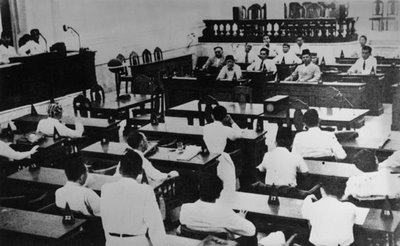
On June 1, 1945, Sukarno delivered one of the most influential speeches in Indonesian history before the Investigating Committee for Preparatory Work for Indonesian Independence (BPUPKI). During his speech, he argued that Indonesia did not need to become a powerful nation before declaring independence. Like every sovereign state under international law (internasionaalrecht), it only required three essential elements: a territory, a people, and a government.
More importantly, Sukarno argued that legal sovereignty alone was not enough. A nation as diverse as Indonesia needed a shared philosophical foundation capable of uniting people across different religions, cultures, and political beliefs. Borrowing a Dutch term, he called this foundation a philosophische grondslag.
“philosophische grondslag itulah pundamen, filsafat, pikiran yang sedalam-dalamnya, jiwa, hasrat yang sedalam-dalamnya untuk di atasnya didirikan gedung Indonesia Merdeka yang kekal dan abadi.”
It was within this context that Sukarno introduced the five principles that would later become known as Pancasila.
Today, Pancasila is commonly understood as Indonesia’s official ideology. Yet Sukarno envisioned something considerably broader. Pancasila was not meant to replace political ideologies or dictate a single doctrine. Instead, it served as a common philosophical foundation upon which different ideologies could coexist while sharing the same commitment to the Indonesian state.
This understanding became evident during Sukarno’s Guided Democracy in the late 1950s and early 1960s. Nationalists, Islamic groups, communists, and other political forces all participated in Indonesia’s political system despite holding fundamentally different worldviews. What united them was not a common political ideology, but a common acceptance of Pancasila as the philosophical foundation of the state.
Perhaps the clearest example of this idea was Sukarno’s concept of Nasakom, an attempt to reconcile three major political currents of Indonesian society: nationalism (nasionalisme), religion (agama), and communism (komunisme). Although the experiment ultimately failed to resolve the intense rivalry among these groups, it reflected Sukarno’s belief that ideological diversity could coexist under the shared umbrella of Pancasila.
Everything changed after the events of 1965.
The attempted coup of September 30, later known as the G30S Movement, marked a turning point in modern Indonesian history. In the months that followed, the Indonesian Army accused the Indonesian Communist Party (PKI) of orchestrating the movement. Political tensions escalated rapidly, leading to widespread anti-communist purges in which hundreds of thousands of suspected PKI members and sympathizers were killed, imprisoned, or subjected to decades of political discrimination.
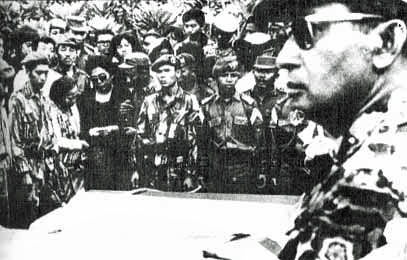
On March 11, 1966, Sukarno issued the Surat Perintah Sebelas Maret (Supersemar), granting Lieutenant General Soeharto broad authority to restore order and national security. Acting under this authority, Soeharto banned the PKI, and later that year the Provisional People’s Consultative Assembly (MPRS) adopted Decree No. XXV/MPRS/1966, formally dissolving the PKI and prohibiting the spread of Marxism-Leninism in Indonesia.
What happened after 1966 alone was enough to significantly reduce Indonesia’s ideological diversity. Yet the transformation did not stop there. During Soeharto’s three decades in power, Indonesia’s political system underwent another fundamental restructuring.
Believing that a fragmented party system threatened political stability, the New Order government reorganized Indonesia’s political landscape. In 1973, dozens of political parties were compelled to merge into just three political forces: the United Development Party (PPP), which united the major Islamic parties; the Indonesian Democratic Party (PDI), which brought together nationalist, Christian, Catholic, and several smaller parties; and Golkar, the government’s own political vehicle. For more than two decades, these three organizations dominated Indonesian politics, leaving far less room for ideological competition than had existed during the early years of the republic.

Another major turning point came in 1985 with the introduction of the Asas Tunggal (“Sole Principle”) policy. Every political party and mass organization was required to adopt Pancasila as its sole ideological foundation. This marked an important shift in the political role of Pancasila. It was no longer understood primarily as a philosophische grondslag, a shared philosophical foundation upon which different ideologies could coexist. Instead, it increasingly became the state’s officially sanctioned ideological framework, whose interpretation was largely determined by the government.

The fall of the New Order in 1998 restored Indonesia’s multi-party democracy. Dozens of new political parties emerged, yet the boundaries of acceptable political ideology remained remarkably narrow. Nearly every major party identifies itself as nationalist, democratic, religious, and committed to Pancasila. Explicitly socialist, communist, or other radical ideological platforms remain absent from mainstream politics, reflecting both the enduring influence of the post-1965 political order and the continued legal prohibition on the dissemination of Marxism-Leninism under MPRS Decree No. XXV/MPRS/1966.
The significance of these developments extends far beyond the disappearance of a single political party. Together, they fundamentally transformed the political function of Pancasila.
Under Sukarno, Pancasila primarily functioned as a philosophische grondslag — a shared philosophical foundation upon which different political ideologies could coexist. Under the New Order, however, Pancasila increasingly became the state’s official ideology, whose interpretation was largely determined by the government itself. Political organizations were no longer simply expected to accept Pancasila as the foundation of the republic, they were also expected to conform to the state’s interpretation of what Pancasila meant.
This transformation reshaped Indonesia’s political landscape for decades to come. Ideological diversity gradually gave way to ideological uniformity. Rather than competing through fundamentally different visions of society, political parties increasingly competed within the same officially accepted ideological framework.
Seen from this perspective, the social media joke no longer seems like just a joke.
If every political party must present itself as equally nationalist, equally democratic, equally pro-people, and equally pro-Pancasila, then perhaps it is not surprising that covering their names would make them difficult to distinguish. Even decades after the fall of the New Order, allegations of communist sympathies still occasionally surface during election campaigns, reflecting how narrow Indonesia’s accepted ideological boundaries have remained since 1965.
Ironically, the five principles of Pancasila have remained exactly the same since 1945. What has changed is not the text, but its political function. The evolution of Pancasila from a philosophische grondslag into an authoritative state ideology continues to shape Indonesia’s political life to this day.
Perhaps that’s why Republican-versus-Democrat jokes rarely land in Indonesia. Our political parties don’t compete over radically different ideologies. More often than not, they compete over who can better represent the same philosophical foundation.