It was in the middle of the night, when half of us were still half asleep. I stood there watching the dark sky, cautious for no real reason, like the night itself might suddenly become important. Just as I was about to close my eyes, someone shouted from the distance, sharp enough to cut through the camp.
“The city’s searchlights are lit!”
Most of us barely moved. Some dismissed it as another drill from the city garrison, another routine exercise against the inevitable raids.
Then the sound came. Not distant. Not delayed. Immediate.
A deep, continuous roar that forced the entire outpost awake at once. That was when we understood it wasn’t a drill. Searchlights rose into the sky, white pillars locking onto something invisible at first.
Then the formation of B-17 Flying Fortresses appeared, moving through the light like it had been waiting for them.
The sky filled with flak fire. Thin tracer lines climbed upward in steady arcs, like stars moving in reverse, until the 88mm bursts bloomed at altitude — brief white detonations that vanished into smoke seconds later. The night stopped being a sky. It became a surface being torn open.
Far beyond the flak bursts, the city began to show itself differently — glows spreading where they shouldn’t, fire reflecting off smoke until everything below looked unstable, half-real.
Silence took over the camp. Then a motorcycle arrived, engine cutting through the noise, stopping hard near command.
“Herr Kommandant,” the rider shouted, breathless. “Your unit is assigned to defend the city. Order effective immediately.” He didn’t wait for acknowledgment. He was already gone.
I looked at the men.
“Pack up the guns,” I said. “We move. Now.”
The moment we arrive, it’s already too late. The city is already in ruins. Orders are unclear, but the assumption is simple — stabilize what remains.
So we enter the city, establish a perimeter, identify survivors, and secure key locations — whatever positions might still survive another raid. We know what happened last night won’t be the last.
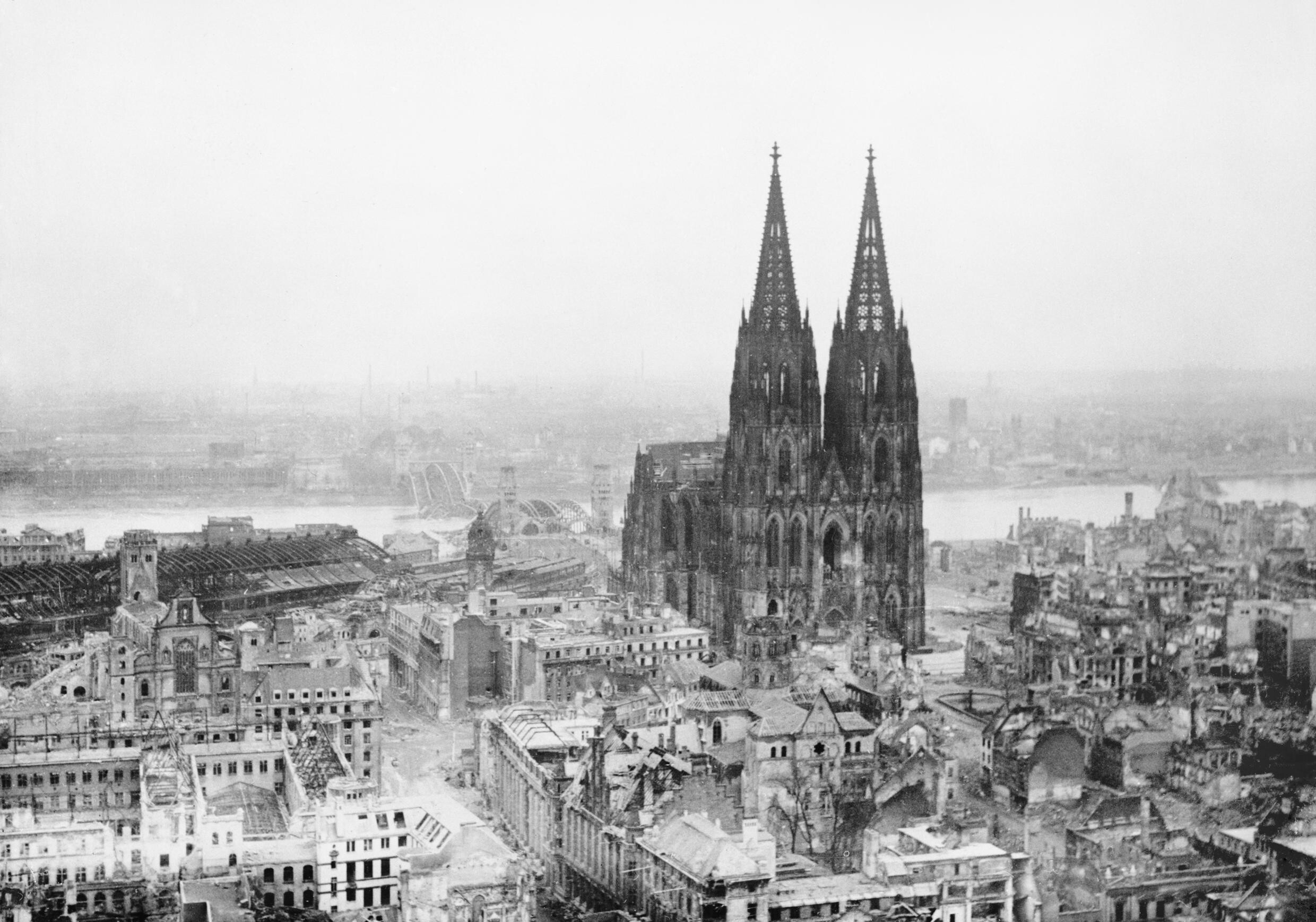
This city is different. The jewel of our country. And I was willing to do anything to defend it. A cathedral can still be seen standing in the middle of the ruins.
Everything around it has already collapsed into rubble. Streets erased beneath debris. Homes reduced to broken walls and ash. At night, the fires reflect against the cathedral windows until the entire structure seems to glow like something still alive inside the dead city.
Days pass like this. The city continues collapsing in slow motion. Not through a single decisive strike, but through exhaustion. Walls remain standing while everything inside them disappears piece by piece.
Every night the sirens return. Every night the searchlights rise again. And every night, we prepare as if preparation still changes something. The men stop speaking about victory after the first week. After the second, even survival becomes a conversation too exhausting to continue.
Still, I refuse to leave.
Because the cathedral still stands. Because some streets still carry names. Because every ruined building seems to contain evidence that this place was once loved by someone. And I convince myself that as long as something remains, then abandoning it would be betrayal.
So I stay, and I wait.
We reinforce checkpoints no civilians use anymore. Guard intersections leading nowhere. Defend structures already hollowed out from the inside. And slowly, without admitting it directly, I begin measuring the city against myself.
If our unit were stronger, perhaps the city would hold on a bit longer. If we were better armed, perhaps the bombers would pass over us for easier targets. If I were more capable, perhaps this place would stop collapsing the moment I touched it.
It takes me longer than it should to understand how arrogant that thought really is. Because the city was never asking to be saved by me.
One night, while reinforcing another barricade near the cathedral square, one of the younger officers stopped beside me. He looked toward the cathedral for a long time before speaking.
“Herr Kommandant,” the Leutnant said quietly, “do you still believe this city can be held?”
I looked toward the cathedral before answering.
“Herr Leutnant — the night those orders came down, you and I already knew how this would end. And yet,” I said, “I came anyway.”
The sirens began again somewhere beyond the ruined streets. Searchlights swept across the clouds like they were still searching for something worth saving. The officer stood there for a few more seconds before speaking again.
“I think some places survive longer after people stop trying to keep them.”
Then he returned to the checkpoint without waiting for a response. And somewhere between the sirens and the falling ash, another thought finally emerged.
Quiet. Humiliating.
Maybe the attacks continue not because I failed to defend the city.
Maybe they continue because I still refuse to leave it.
Maybe this place had been trying to let go long before I ever arrived.
Maybe this city was always going to survive under someone else’s command, just not mine.
I cannot tell whether I stayed because I loved the city — or because I could not bear the thought that it simply did not need me enough to stay standing.